Inspired by the work of Gabor Maté
Estimated reading time: 4 minutes
What if some of the things we have learned to call normal are actually signs that our bodies and minds have been adapting to too much for too long?
This is one of the questions that stayed with me while reading The Myth of Normal by Gabor Maté, written with Daniel Maté.
The book invites us to look at health differently—not only by asking what is happening inside a person, but also by looking at the environment in which that person has been living.
When “normal” doesn't necessarily mean healthy
Many experiences have become so common that we barely question them.
- Always being busy.
- Feeling guilty when we rest.
- Putting everyone else's needs before our own.
- Ignoring exhaustion because there is still more to do.
- Staying productive even when our body is asking us to slow down.
We may become very good at functioning this way.
But functioning and feeling well are not always the same thing.
One of the ideas I appreciate in The Myth of Normal is the invitation to become curious about what our symptoms, emotions, and patterns may be communicating.
Instead of immediately asking:
What is wrong with me?
We might begin asking:
What has my mind and body been adapting to?
That small change in the question can create a very different kind of conversation.
Our experiences don't happen only in our minds
Stress is not simply a thought or an emotion.
When we experience pressure, uncertainty, conflict, disconnection, or a sense that we have to keep going despite being overwhelmed, the body responds too.
Our nervous system is constantly paying attention to what is happening around us and inside us.
- Do I feel safe?
- Do I need to protect myself?
- Can I relax here?
- Do I have enough support?
Over time, prolonged stress can influence sleep, muscle tension, digestion, energy, mood, concentration, and many other aspects of our well-being.
This doesn't mean that stress explains every physical symptom or illness. Our health is complex, and biological, genetic, environmental, social, and psychological factors can all play a role.
But it does mean that the body deserves to be part of the conversation.
The cost of always being “the strong one”
This part of the book made me think especially about women who have spent years taking care of everyone around them.
Sometimes being strong means becoming very skilled at pushing through.
- You keep working.
- You keep caring for people.
- You say yes when part of you wants to say no.
- You minimize your own needs.
- You tell yourself, “I'll rest later.”
Eventually, this can become so familiar that we don't even notice how much effort it takes.
Then something changes.
Maybe sleep becomes more difficult. Maybe anxiety increases. Maybe the body feels different. Maybe hormonal changes arrive. Maybe there is a medical diagnosis. Or perhaps the strategies that helped us keep everything together simply stop working as well as they once did.
And suddenly the body becomes difficult to ignore.
Perhaps the body isn't the enemy
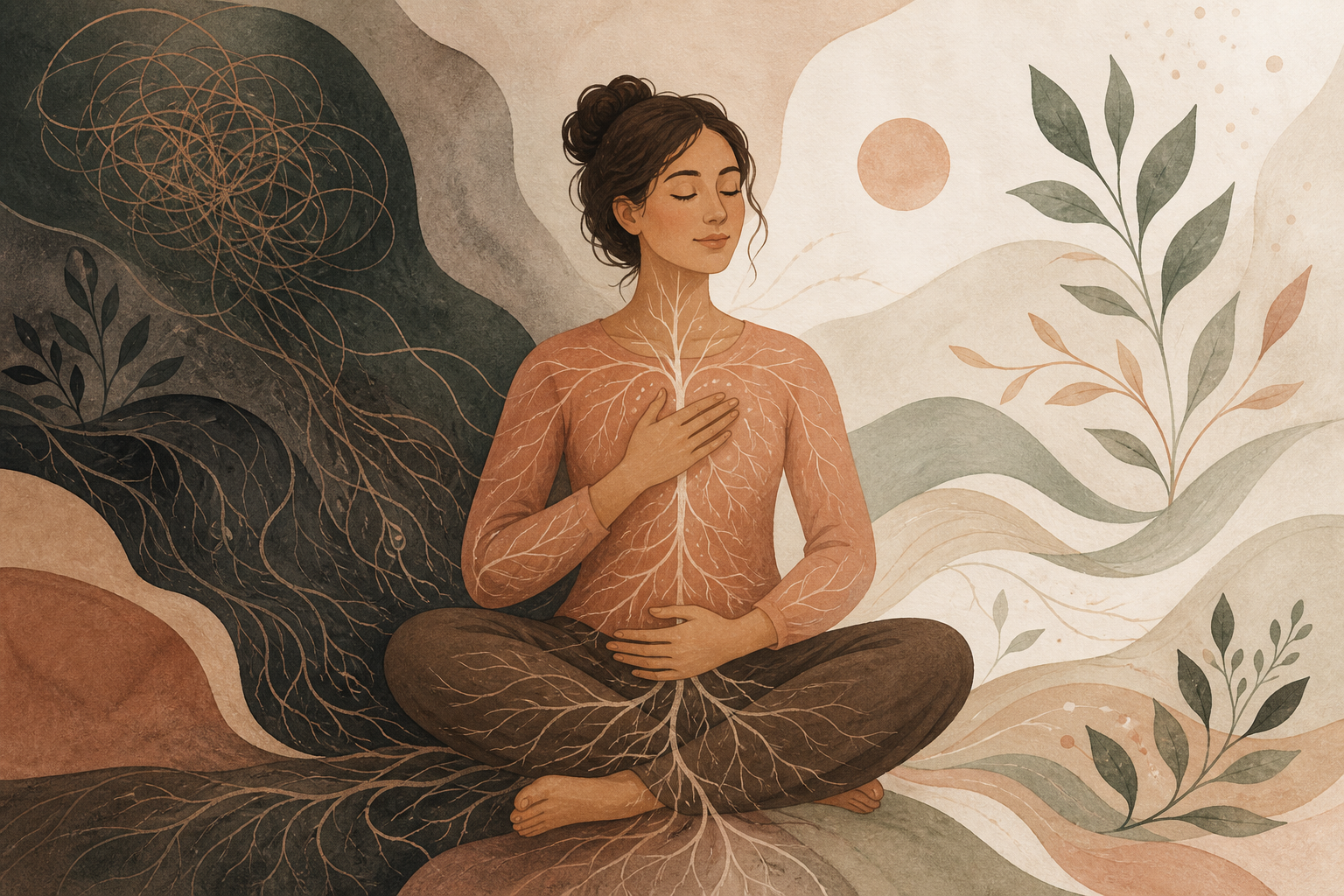
One reflection I took from this book is that we can become curious about the body rather than immediately fighting against it.
- A racing heart.
- A tight chest.
- A tense jaw.
- Exhaustion.
- Restlessness.
- The feeling that you cannot fully relax even when nothing is obviously wrong.
These experiences can sometimes be understood as a nervous system that has learned to stay prepared.
Rather than asking only, “How do I make this feeling disappear?”, another question becomes possible:
What might my body need right now?
- Maybe it needs rest.
- Maybe a boundary.
- Maybe connection.
- Maybe movement.
- Maybe support.
- Maybe permission to feel something that has been pushed aside for a long time.
And sometimes we don't immediately know the answer.
Curiosity can be enough to begin.
A different definition of healing
Healing doesn't necessarily mean becoming a person who never feels stressed, anxious, angry, tired, or overwhelmed.
Life will continue to bring uncertainty and change.
Perhaps healing is also about developing a different relationship with ourselves.
- Noticing sooner when something feels like too much.
- Listening when the body whispers instead of waiting until it has to scream.
- Recognizing our limits.
- Allowing ourselves to receive care rather than always providing it.
- Learning that rest does not have to be earned.
- And slowly discovering that our needs deserve space too.
A question to take with you
As you move through your week, notice the moments when you automatically push yourself to keep going.
Then, without trying to change anything immediately, ask:
If I didn't have to prove that I could handle everything right now, what would I need?
Notice what comes up.
The answer might be surprisingly simple.
This reflection was inspired by themes explored in The Myth of Normal: Trauma, Illness, and Healing in a Toxic Culture by Gabor Maté, MD, with Daniel Maté. It is intended for reflection and psychoeducation and is not a substitute for medical or mental health care.